Were happy to announce that ComforTrack Plus shades were featured in the October 2011 edition of the This Old House magazine! Compared to Hunter Douglas’ Duette Architella, Symphony Shades pay for themselves especially with the side track system which blocks light and drafts! Read More
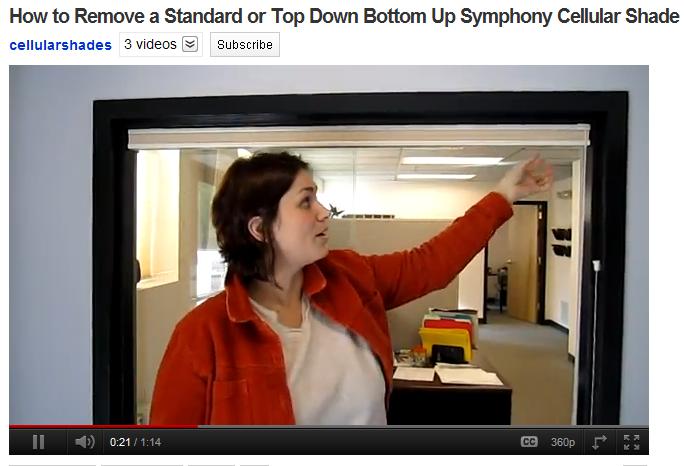
How to Remove a Shade!
This video speaks specifically of the smoothy cord loop and our top down bottom up shades. Clicking the image below will take you to the video!
Is Your Blind Past It?
Although it’s hard to step back and remember what an item, a cellular shade for instance, looked like when it was new, some repairs people send in leave a lot to be desired — which begs the question:
“When Should My Shade Be Replaced??”
This photo illustrates the EXTERIOR-FACING side of two shades; New at the bottom and “Aged” (to be kind) at the top:
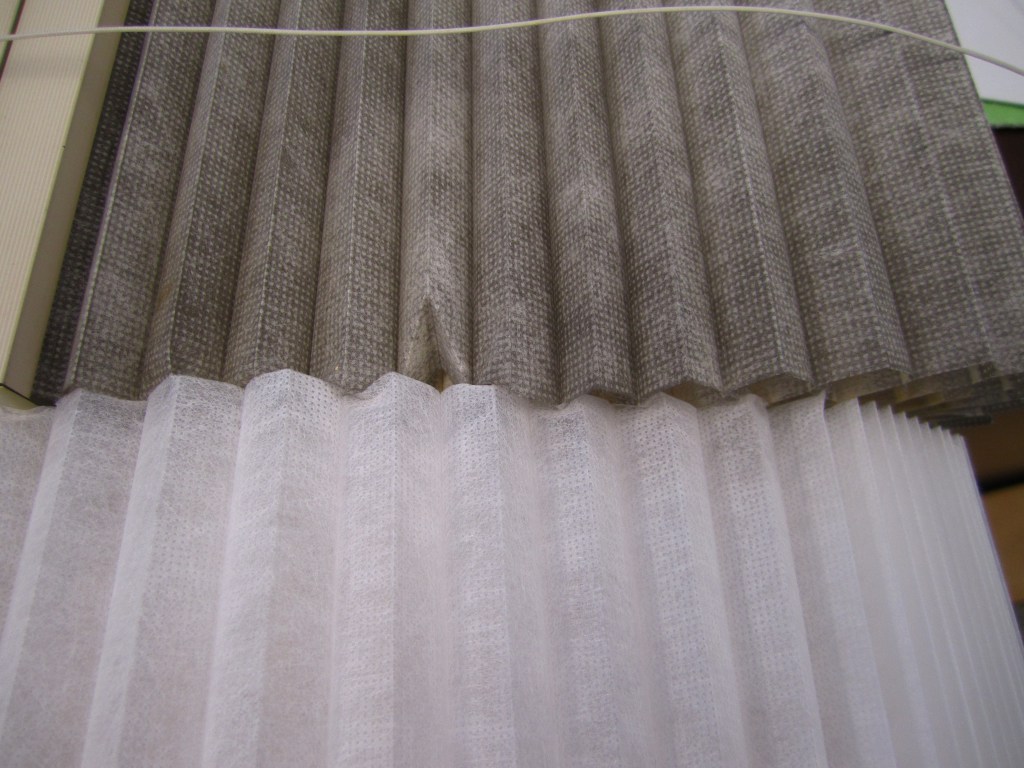
They are the same shade fabric and color… truly.
Market Ready?
A useful article surfaced in the last (21 Sept 2011) New York Times “home” section – especially as the push is on, here in the north, to sell a home/buy a home before the snow flies!
The Tim McKeough series on preparing your home for being “Market Ready” purports to be the first in a series. You’ll find some useful items in this installment:
• Does wall color — for instance, a bright red or perky pink — inhibit potential buyers from “picturing themselves” at home in your space?
• Should you upgrade kitchen appliances, especially if they are “dated” (ie, in color) though still in good working condition?
Readers can even submit their own questions about “home repairs or decorating in preparation for selling”!
 Read More
Home Security and Your Shades
Now that’s its September, Snowbirds (as northerners who winter in the south are known hereabouts) are about to leave their summer homes. Some of these homes are long-in-the-family residences; others are small seasonal camps or cabins on lakeshores, or even mobile homes in summer-only trailer parks.
But, let’s face it, all our “homes” are filled with all our “stuff”!

It’s a Small World After All
Over the last few days we have received one call and several emails from “Down Under”: New Zealand and Australia!

(neat map, huh! There’s more at Flourish.org)
Dye Lot Dilemma
From Wikipedia, which spends most of this article’s discussion of dye lots by referencing knitting/crocheting projects, towards the end comes up with this handy little tidbit for other “walks of life.”
Dye lot in other uses
Use of the same dye lot or run number may also be important in other applications, such as: Wallpaper, fabrics for drapes and other uses, carpets, flooring, tiles, etc.
Add to that cellular shade fabrics!
Have you ever tried to match Whites? All whites are not created equal!
How about Blacks? Some are blue, others are a stark black.
Or Reds that are slightly more or less orange.
This is similar to a Dye Lot Dilemma — one batch of dye will rarely match exactly another batch. Add into that mix, for window shades, daily usage, in windows, and you’ve a scenario where “a good match” will be all one can hope for rather than pining for “an exact match”. Read More
To Hold Down or not to Hold Down?
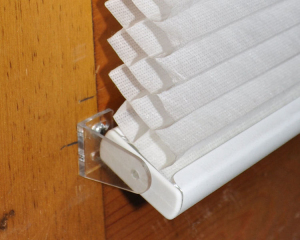
It’s always guesswork, when applying a shade to a door, whether HOLD DOWNS are appropriate or no. The giveaway is when a hold down is viewed:
Therapy for Your Apartment!
As much as we all might wish to live in large houses — with terrific views, on extensive tracts of land — the U.S. is a nation where more of us live in metropolitan areas, sometimes even in highrise buildings.

One of the greatest inventions for the shade industry is the top down bottom up shade. The one pictured above is pulled down more than half-way, but it illustrates the wonderful privacy versus light debate that you don’t necessarily have to address. Read More
Saving Antiques through Window Treatments
Last week I spoke with a Californian who still gets too much sun, despite having obtained tinting for the windows.
We all know the damaging effects of the sun’s rays. In researching for this piece, I unearthed this article dealing with Pittsburgh’s CLAYTON MANSION. Built in 1860, “a gem of Victorian architecture”, the Clayton Mansion houses “priceless antiques, art, handpainted wallpaper, and rare fabrics”.

Clayton was the home of Henry Clay Frick. According to the museum’s website, the Fricks purchased Clayton for $25,000 in 1882. The house was smaller then: eleven rooms, and on 1.43-acres of land. “An astonishing 93% of the artifacts in the house are original”. Read More
